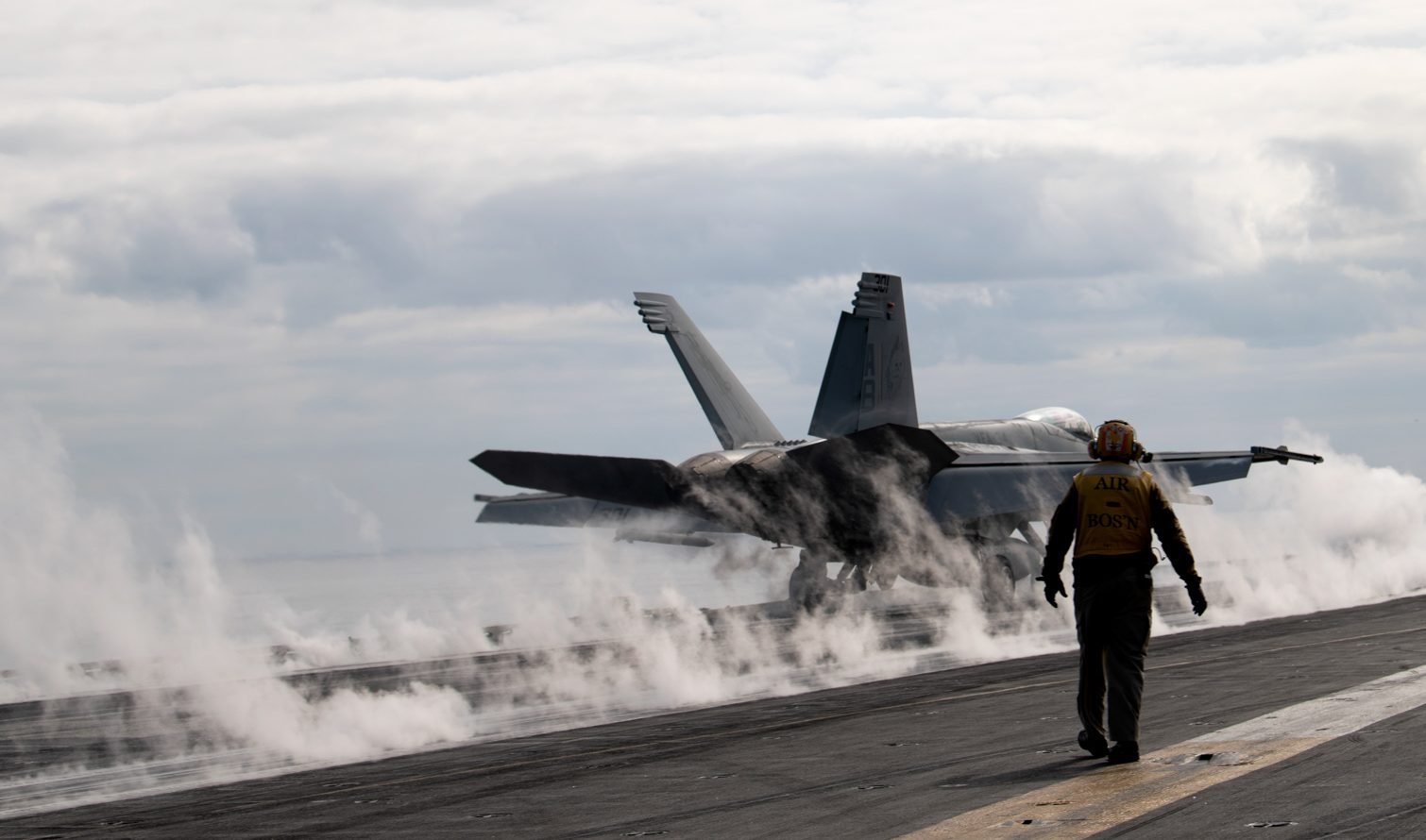
A F/A-18E Super Hornet from the ‘Blue Blasters’ of Strike Fighter Squadron (VFA) 34 prepares to launch from USS Harry S. Truman (CVN-75) on March 17, 2022. USNI News Photo
ABOARD AIRCRAFT CARRIER USS HARRY S. TRUMAN IN THE IONIAN SEA – For the longest stretch in a long time, the Mediterranean Sea has performed host to the deafening roar of U.S. service plane launching into Europe.
Since December, the Harry S. Truman Carrier Strike Group, Carrier Air Wing 1 and its escorts have been working within the Adriatic and Ionian seas launching 80 to 90 sorties a day as far north as Lithuania for a spread of missions with NATO-allied plane from Romania, France and Italy. Some fighters launched from Truman are coaching, whereas some are set to police NATO’s airspace and forestall Russian plane from violating these borders.
“And so we’re here to deter,” Secretary of the Navy Carlos Del Toro advised reporters aboard Truman. “We’re here to work together, as members of NATO together, to protect each other, and to care, to provide as much support to the Ukrainian people [and] to the Ukrainian government.”
On Thursday, USNI News spoke with the pilots flying the patrols on NATO’s jap entrance about how Truman and its air wing slot in with the bigger alliance mission because the warfare rages in Ukraine.
The enhanced air policing is one kind of deterrence the United States is doing in hopes of dissuading Russian President Vladimir Putin from additional aggression, Del Toro, who was launched into the ship Thursday, stated.
As half of the Ukrainian invasion, the Russian Navy has massed ships within the Eastern Mediterranean centered on its sole international naval base in Tartus, Syria. Those forces embrace two Slava-class guided-missile cruisers – RTS Marshal Ustinov (055) and RFS Varyag (011) – designed to tackle U.S. and NATO plane carriers.
The Truman CSG is joined within the Mediterranean by different ships from NATO, together with FS Charles De Gaulle (R 91) and the Italian plane service ITS Cavour (CVH 550). But Russian ships and submarines are additionally within the space, Del Toro stated. Deterring these ships working within the Eastern Mediterranean are a significant half of the Truman CSG’s mission in addition to the policing operation over NATO nations in Europe.
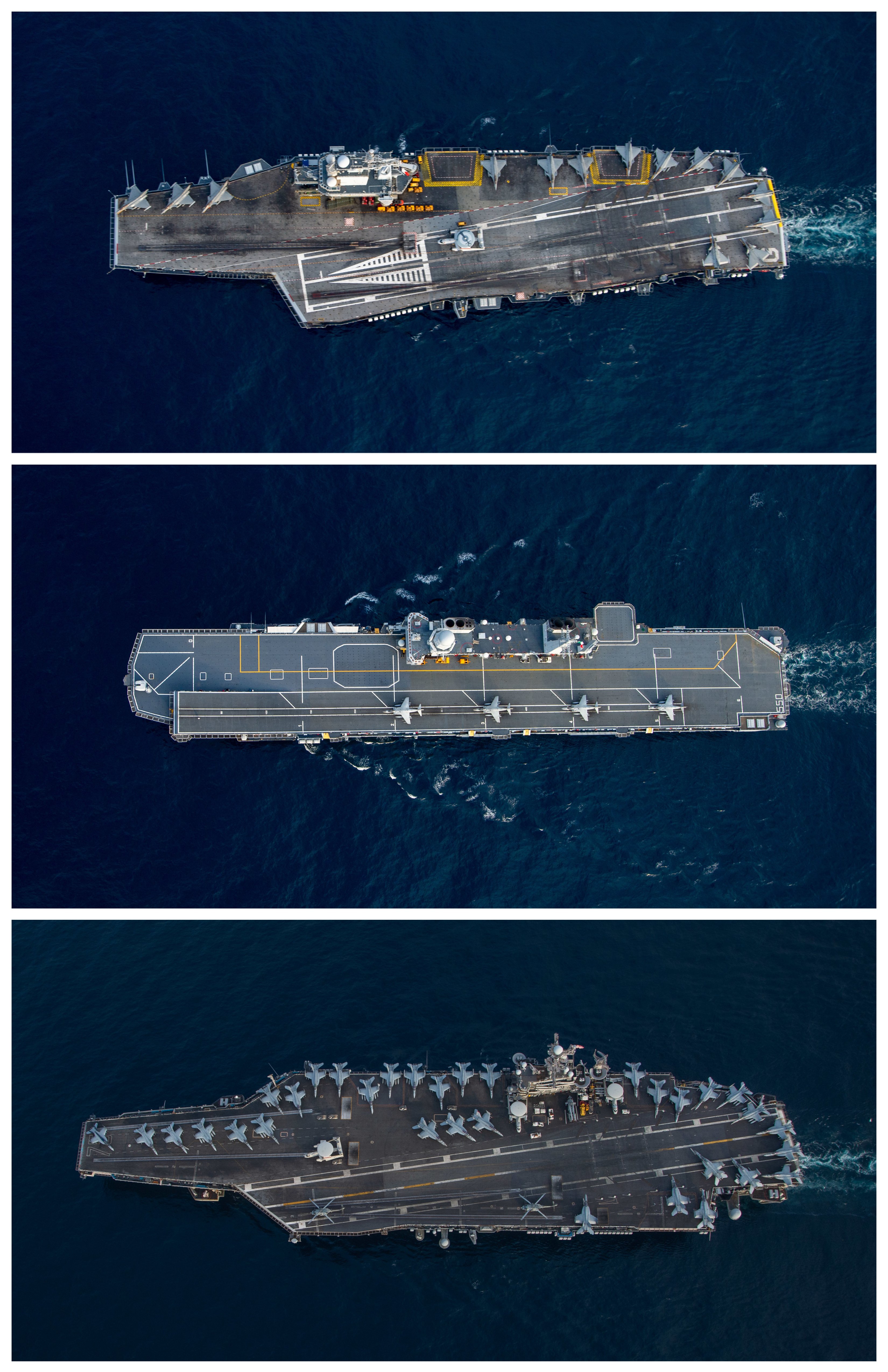
From prime to backside: French service FS Charles De Gaulle (R 91), Italian plane service ITS Cavour (CVH 550) and USS Harry S. Truman (CVN-75). US Navy Photos
The result’s the deafening, body-shaking vibrations which are a day by day occurence aboard the flight deck. The service’s catapults have been taking pictures plane as much as 90 occasions a day because the strike group acquired to the Mediterranean.
While the aircrafts is perhaps half of NATO’s enhanced air policing or coaching with allies, the day-to-day on the service isn’t all that totally different, stated Lt. Cmdr. John Pavalok, the assistant air ops on Truman.
“The aircraft are flying. They fly in-country, do the mission, and then they return,” Pavalok stated. “So [from] our perspective, it’s all the same to us.”
While Truman is not below NATO command, when the plane be part of the policing mission, they’re flying a NATO mission, stated Capt. Patrick Hourigan, commander of Carrier Air Wing 1, advised USNI News.
“It is minimally different,” Hourigan stated. “There are very slight changes to the rules of engagement because we operate under NATO rules of engagement versus strictly U.S. rules of engagement. That’s about the only change.”
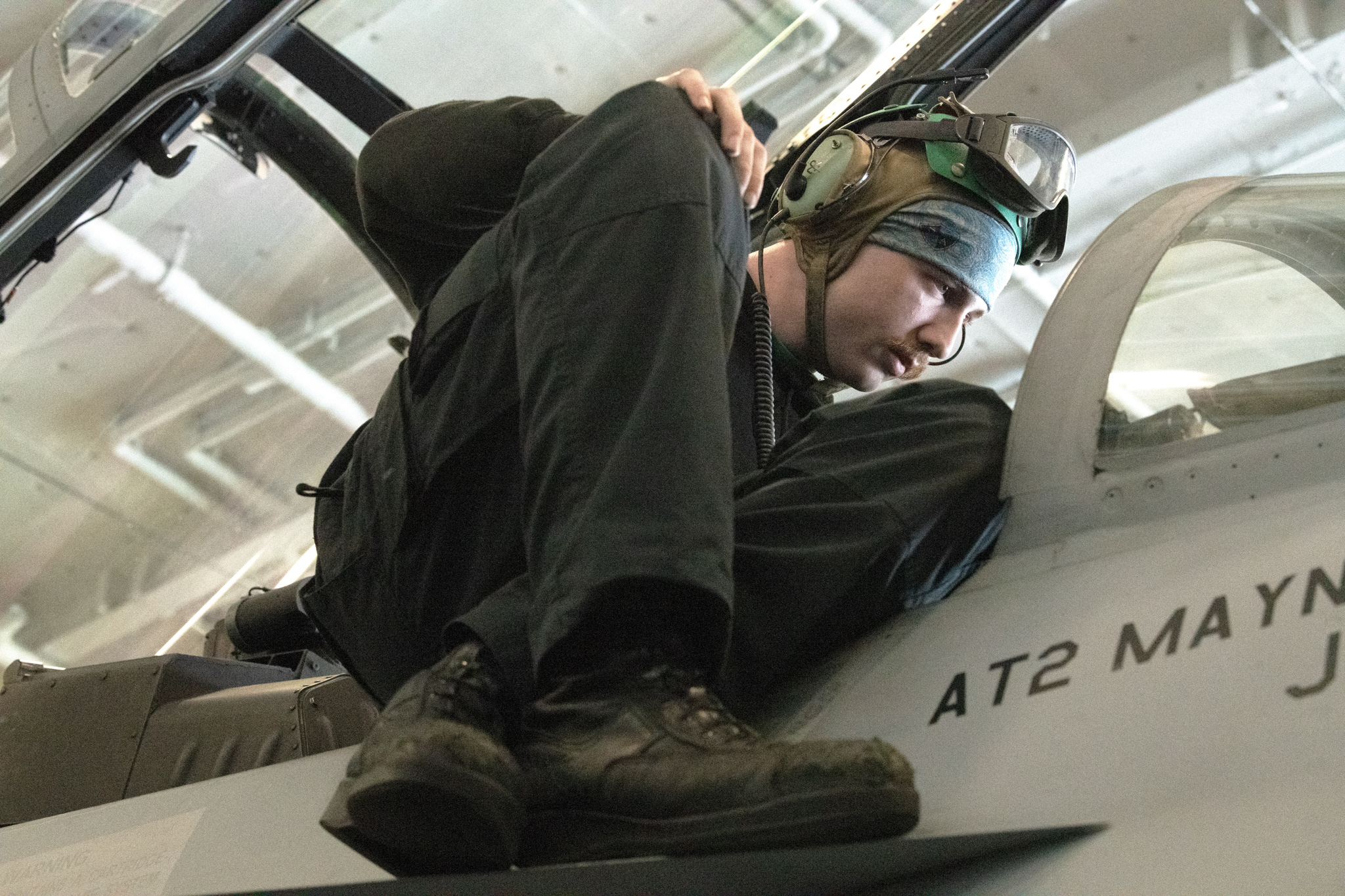
A sailor engaged on a F/A-18F Super Hornet within the hangar bay of USS Harry S Truman CVN-75). USNI News Photo
Hourigan wouldn’t say the place the plane from Truman are working, saying simply that they had been flying inside NATO airspace. Before the Russian invasion, plane from Truman flew from the Mediterranean as far north because the Baltics.
Alliance leaders have been clear about defending NATO airspace from Russian incursion because the warfare continues.
“We are very closely monitoring airspace and the border areas around NATO,” NATO Secretary General Jens Stoltenberg stated this week. “Our military commanders also have lines to the Russian commanders to help prevent incidents and accidents, and to help prevent them from spiraling out of control if they happen.”
This week, reviews emerged of Russian drones crashing in Romania and Croatia. A Russian drone was additionally noticed over Poland and downed by Ukrainian forces, in accordance with The Wall Street Journal.
Back within the Mediterranean, the ships within the Ionian Sea have been working in live performance, Hourigan stated. On Thursday, plane from Truman, Italian AV-8B Harrier IIs flying from Cavour and French plane from Charles de Gaulle participated in an air protection train. During enhanced air policing, aircrafts depend on NATO tankers for fueling, that are nearer to the airspace that’s being held, he stated.
“So we have a process called the ATO, which is the Air Tasking Order,” he stated. “And that comes out every day, and tells you down to where to meet, how to talk to them, how much gas to expect. And then we do this often enough that the interoperability is already there.”
It’s an opportunity to train with one other nation’s plane, talking particularly about an train with Romanian plane final month, Hourigan stated.
“Every airplane is unique and different,” he stated. “Some go faster, some turn tighter, and getting to work with other countries allows you to just experience that and what it’s like to either work with or [simulate a] fight against an aircraft with different performance characteristics.”
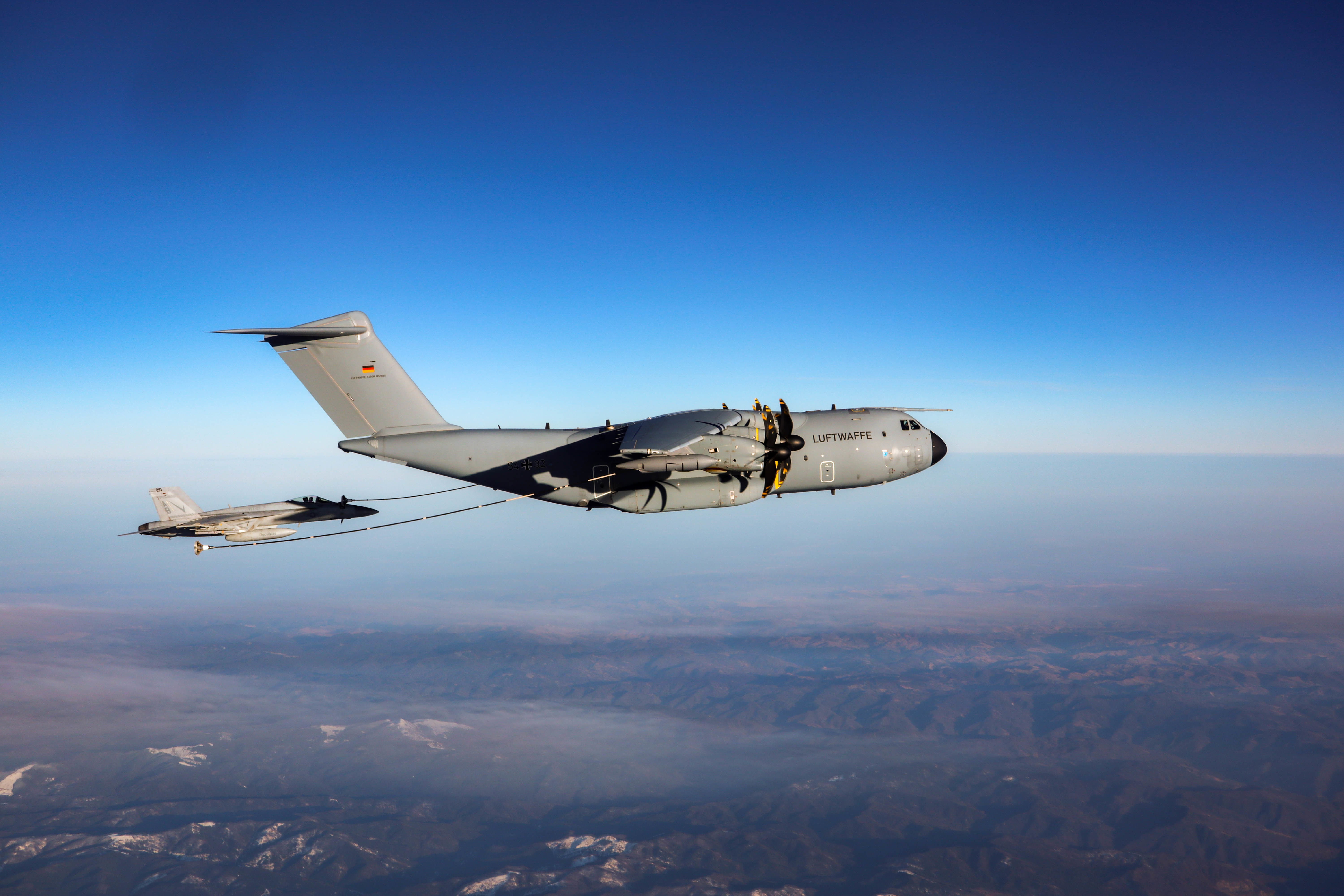
A German Air Force A400M Tanker refuels an F/A-18E Super Hornet, hooked up to the “Fighting Checkmates” of Strike Fighter Squadron (VFA) 211 on Feb. 25, 2022. US Navy Photo
The enhanced policing is finished in partnership, Hourigan stated. Each nation has a location to patrol.
“And occasionally there’ll be aircraft from more than one country on station at the same time,” he stated. “Other times we take turns. So when our aircraft come back, they may be replaced by Air Force assets, they may be replaced by Romanian assets, like the German aircraft, it varies day by day, based on the air tasking order.”
NATO nations assist one another with fueling, stated public affairs officer Lt. Cmdr. Shawn Eklund. That refueling is how the planes can keep within the air longer.
But the NATO allies additionally work collectively on the water’s floor, Eklund stated. Royal Norwegian Navy frigate HNoMS Fridtjof Nansen (F310) deployed with Truman in December and Truman has operated with French and Italian ships since December.
In late January, the service was the lead ship for Neptune Strike, an train that positioned the service below NATO management. Under the state of affairs, F/A-18E/F Super Hornets from Truman operated as far north as Lithuania within the Baltics, Hourigan stated.
The policing missions aren’t only for fighters. E-2D Advanced Hawkeyes are being flown by the “Seahawks” of Airborne Command & Control Squadron 126 (VAW 126), stated the squadron’s commanding officer Cmdr. Chuck Cline.
The E-2D has two roles within the patrol mission, Cline stated. It is an airborne sensor and a decision-maker.
“They take my airplane up, and then they go out there with the commander’s intent,” Cline stated. “And they go and make decisions based off what they see on the radar and what they know is going on.”
They’ll go between 15,000-30,000 ft within the air and run the radar, calling again to the ship to make selections.
“We provide 360-degree coverage around the strike group…We get to see what’s around us. So we get the big picture,” Cline stated. And from there, we make selections, we execute. We inform folks the place to go, what to do, issues like that.[…] We’re principally the quarterback of the sky for lack of a greater time period.”
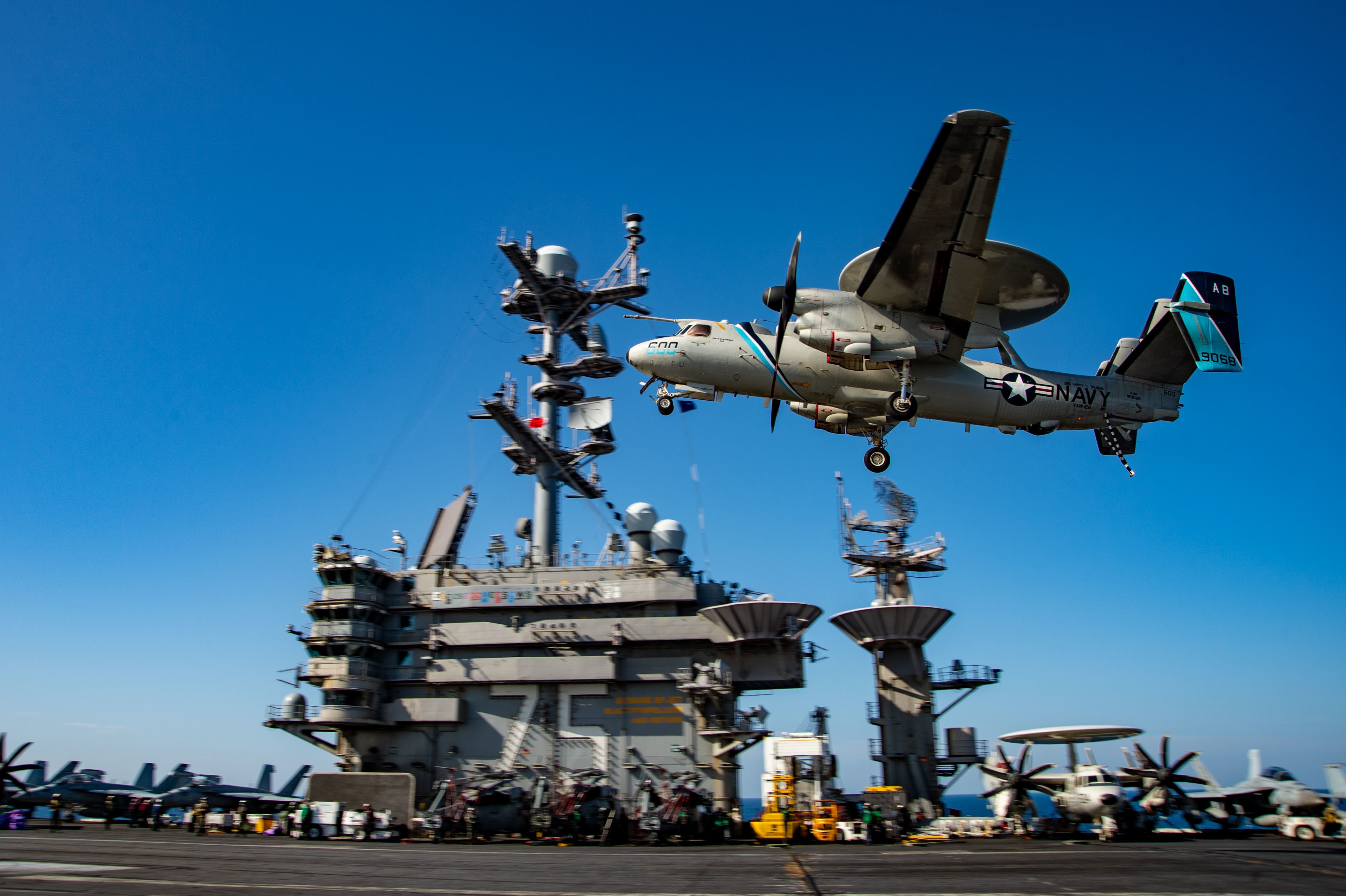
An E-2D Hawkeye, hooked up to the ‘Seahawks’ of Airborne Command and Control Squadron (VAW) 126, flies over the flight deck of the Nimitz-class plane service USS Harry S. Truman (CVN-75), Feb. 21, 2022. US Navy Photo
What makes the “Seahawks” particular is that they can do aerial refueling, the primary E-2D squadron to take action, Cline stated.
That refueling means the planes can go for for much longer, as much as 10 hours as an alternative of 5.
Lt. Richard Wood, with VAW-126, did a five-hour flight Thursday, one thing that’s attainable as a result of of the flexibility to refuel within the air, he advised USNI News.
“Around the boat, it makes us incredibly flexible,” Wood stated. “We’re not limited to some boat cyclic operations.”
A cycle is usually one hour to 1 and a half hours, he defined, with the squadron historically doing a triple cycle. Instead, pilots can do for much longer flights on the request of the air commander.
“On this specific deployment, it’s been a huge asset to us to be able to execute the enhanced air-policing mission, going from where we’ve been operating here in the Mediterranean, all the way into Eastern Europe,” he stated. “Those flights require a significant amount of aerial refueling.”
Getting gasoline within the air is simpler to do when it simply means going to a different embarked squadron on the ship and speaking about fueling wants, Wood stated.
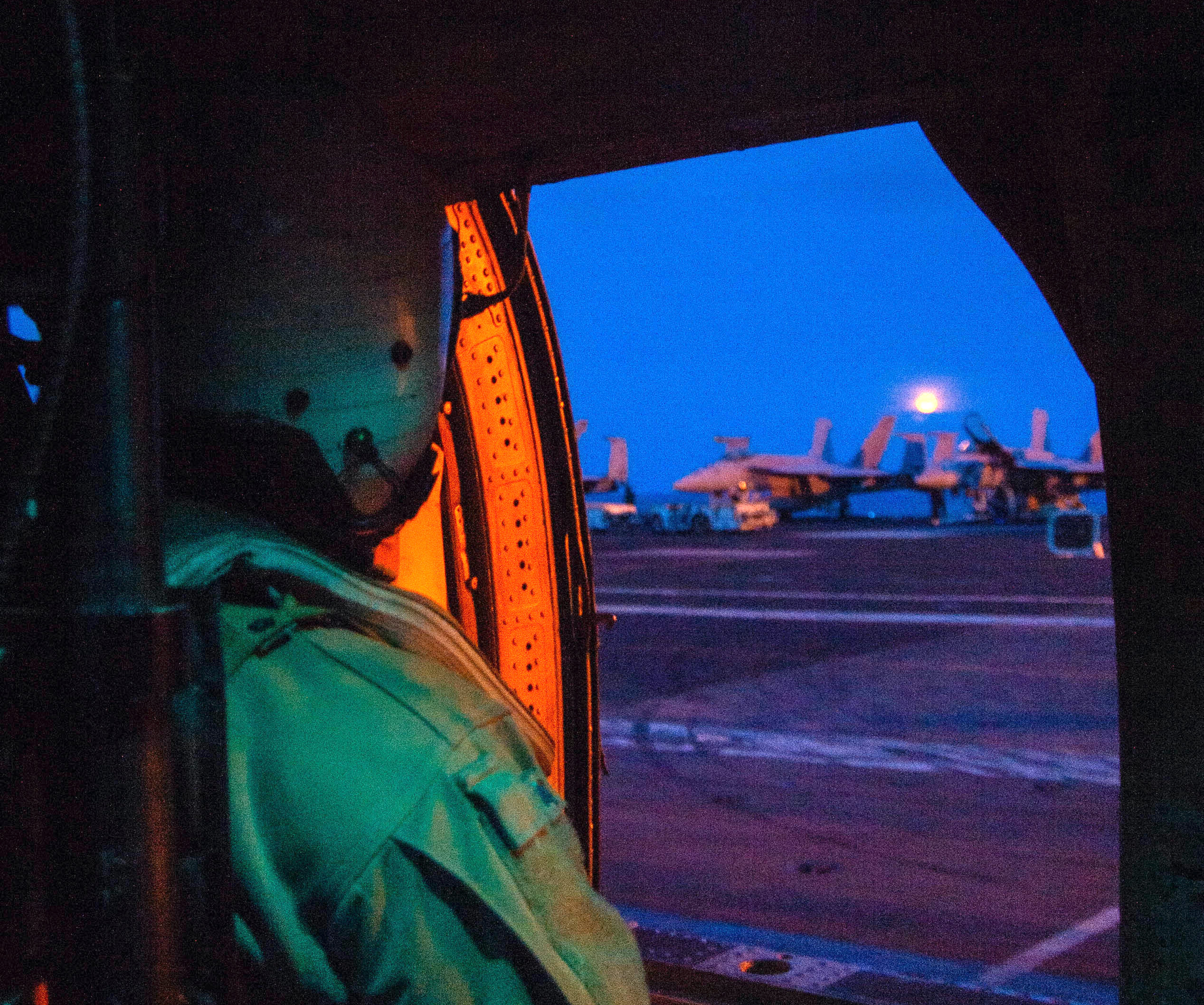
Naval Air Crewman (Helicopter) 2nd Class Bowie Demers, from Springfield, Tennessee, assigned to the “Dragonslayers of Helicopter Sea Combat Squadron (HSC) 11, takes off in an MH-60S Knight Hawk helicopter from the Nimitz-class plane service USS Harry S. Truman (CVN-75), Mar. 17, 2022. US Navy Photo
“It’s been really nice right here on the boat, we can walk right next door and say, ‘Hey, we’d love to go get some gas today’ or ‘We’re on the airplane, we’re scheduled to come get gas for you guys.’ It makes the coordination super easy to get organic gas,” Wood stated.
Tanking up is more durable when plane must depend on tankers exterior the air wing requiring coordination between the U.S. Air Force and different NATO refuelers, he stated.
At the second there’s a dependable refueling community over Europe, so it’s not gasoline that limits flights, however somewhat pilot fatigue. It is like with the ability to go to a floating gasoline station, Wood stated – one which comes with the reassurance {that a} flight can go for 5 hours and nonetheless come again with gasoline.
“So it’s a different mentality for the pilots to not be as always concerned about where your gas is and to have the ability to go get a little extra, stay up when CAG [Hourigan] needs us to and then execute these longer missions,” he stated. “It’s an awesome capability.”